Azifo Blog | Tips, Safety & Guides
Buying Used Clothes and Children's Items: Quality and Safety Checks
Children outgrow clothes, toys and gear faster than anyone can wear them out. That makes second-hand a sensible choice for many families, and a good way to reuse things that are still in great shape. But children's items fall into two very different groups: ordinary things where the main questions are comfort and condition, and safety-critical products where a hidden problem can cause serious harm.
This guide is general information. For a specific product, follow the manufacturer's instructions and the guidance of your national consumer-safety authority.
Group 1: Ordinary clothing and shoes
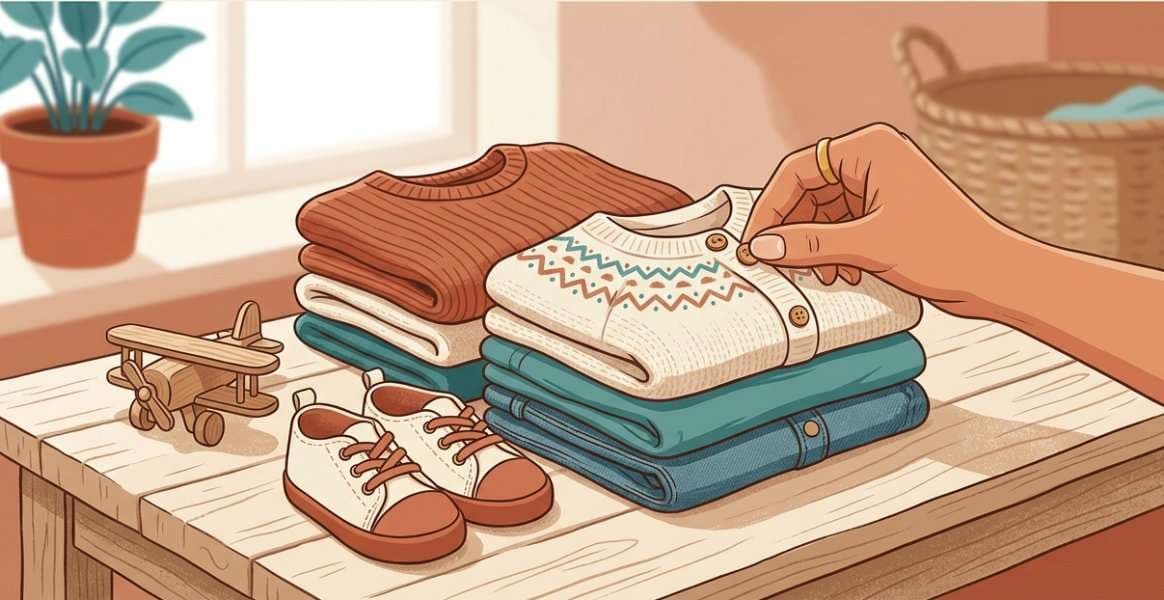
Used clothes are usually a great buy. Check them in good light.
- Fabric: thin patches, stretched elastic, holes, pilling and faded areas.
- Stains and smell: persistent stains, damp or smoke odours can be hard to remove.
- Fastenings: zips that run smoothly, buttons and snaps firmly sewn on.
- Seams and hems: loose threads, split seams.
- Size and growth: ask for the stated size and compare with a garment your child already wears.
- Shoes: look at the soles, the heel wear and the insides. Worn shoes can fit differently, so try them on rather than guessing.
Wash everything before the first wear, following the care label.
Clothing details to look at carefully
- Long cords, strings or drawstrings around the neck or hood can catch on things. Avoid garments with long loose cords.
- Small decorations, beads, sequins or badly attached buttons can come off. Press and tug them gently.
- Itchy labels, rough seams or tight elastic can bother a child, so check the inside as well.
Group 2: Toys and other everyday items
Look for cracks, sharp edges, loose parts and anything that could break into small pieces. Check that battery compartments close securely, and that there is no corrosion. Avoid items with a strong chemical smell or peeling paint. Wash or wipe items that go near the mouth, using a suitable cleaner.
Group 3: Safety-critical products
Some products protect a child in an accident or during sleep, and their condition cannot be judged just by looking. Examples include car seats, helmets and cots or cribs.
For these, the safest approach is to buy new. If you are considering a second-hand one at all, do so only when:
- you know exactly who owned it and how it was used, for example from a family member or a friend you trust,
- you can confirm it has never been in an accident, dropped or damaged,
- all original parts, labels and the instruction manual are present,
- it is not past any expiry or recommended lifespan stated by the manufacturer,
- you have checked for recalls with the manufacturer or the safety authority.
Do not buy these items from a stranger with an unknown history, even at a very attractive price. Damage can be invisible, and a seller's word is not a safety test.
Ask the seller
- How old is the item, and how often was it used?
- Has it been repaired, washed or stored in damp conditions?
- Are the original box, instructions and accessories included?
- Why is it being sold?
Quick checklist
- Clothes: fabric, fastenings, small parts, long cords, smell.
- Toys: cracks, loose pieces, batteries, paint.
- Safety-critical items: buy new, or only with a fully known history.
- Wash and clean everything before use.
- Look up recalls where relevant.
Giving good items a second life is kind to families and to the planet. If you find them on AZIFO or anywhere else, check carefully, and when it comes to a child's safety, choose caution over a bargain.

Welcoming a Cat or Dog: A Responsible Preparation Guide
A kitten or a puppy arrives in one afternoon, but the commitment lasts for years. The best moment to ask hard questions is before you fall in love with a photo. This guide helps you decide whether you are ready and, if you are, prepare calmly.
It offers general guidance only. For anything about an animal's health, a veterinarian is the right person to ask.
Ask yourself honestly first
- Time: who will feed, walk, play with and clean up after the animal every day, including weekends and holidays?
- Budget: food, veterinary care, vaccinations, identification, supplies and unexpected costs all add up over many years.
- Housing: does your landlord or building allow pets? Is the space suitable for the animal's size and energy?
- Household: does everyone agree? Does anyone have allergies?
- Future: what will happen if you move, travel or your circumstances change?
If several answers are uncertain, waiting is a responsible choice.
Choose the right animal for your life
Energy, size, age and temperament matter more than looks. An active young dog needs far more time than a calm adult cat. An adult animal often has a more predictable character than a baby, and many adult animals are waiting for a home. Local shelters and rescue groups can help you match an animal to your situation.
Ask questions before agreeing
If you are speaking to an owner or a seller, ask:
- How old is the animal, and how do you know?
- Where was it born, and who are its parents, if known?
- Has it seen a veterinarian? Are there any vaccination or health records?
- How does it behave around people, other animals and children?
- What does it eat, and what is its daily routine?
- Why is it being rehomed?
Ask to meet the animal in person and observe how it looks and moves. Be careful with offers that ask you to pay before meeting the animal, or that pressure you to decide the same day. If an animal looks unwell, thin or frightened, step back and consider contacting a veterinarian or a local rescue group rather than buying out of pity.
Prepare your home
Before the animal arrives, get the basics ready:
- food and water bowls, and the food it has been eating,
- a bed or a quiet corner,
- a litter tray and litter for a cat, or a lead, collar and harness for a dog,
- toys and, for cats, a scratching post,
- a carrier for the trip home and the vet visit.
Remove hazards: loose cables, small objects, toxic plants and cleaning products within reach. Secure balconies and windows.
Plan the veterinary visit
Book a first appointment soon after arrival. Your veterinarian can examine the animal, advise on vaccination, parasite control, feeding and neutering, and talk about permanent identification such as a microchip. Follow their advice rather than guesses from friends or the internet, because needs depend on age, health and where you live. Keep the records safe.
The first days
Give the animal a quiet space and let it explore at its own pace. Keep a regular routine for meals and toilet breaks. Introduce family members one at a time, and supervise children. Do not overwhelm a new arrival with visitors.
Quick checklist
- Time, budget, housing and household are ready.
- The animal suits your lifestyle.
- You have asked about age, origin, health and behaviour.
- The essentials are at home and hazards are removed.
- A veterinary visit is booked.
A pet is a living companion, not an object. If you are browsing ads on AZIFO or anywhere else, remember that the best preparation is thinking ahead, and the kindest decision is sometimes to wait.

Classifieds Scams: Recognising Requests for Fake Shipping Fees
The message looks friendly and the deal looks easy: a buyer who wants your item without seeing it, or a seller offering a bargain far away. Then comes the twist: a small fee to "release" the package. Requests for shipping, insurance or customs fees are one of the most common ways people lose money in online classifieds. Knowing the pattern makes it easier to stop.
How the scheme usually works
The details change, but the structure is often the same.
- The hook: someone shows great interest, offers to pay the full price at once, or advertises a very low price for something in demand.
- The distance: they cannot meet in person and suggest a courier, a "transport company" or a third party that will handle everything.
- The fee: you are asked to pay a delivery, insurance, customs, "verification" or "release" fee before anything is delivered or paid.
- The pressure: the message says the package will be returned, the offer will expire or someone else is waiting.
- More fees: after the first payment, another cost appears, and then another.
Once you transfer money, the person usually disappears or keeps asking for more.
Warning signs
- You are asked to pay a fee before you receive the item or the money.
- The other person insists on a specific payment method, or asks for a transfer to a person or account you do not know.
- You receive a link to a "courier" or "payment" page that you did not request. Do not open it or enter card details or codes.
- A buyer offers more than the asking price and asks you to refund the difference.
- The conversation moves quickly to another messaging app, and the story keeps changing.
- The messages are urgent, emotional or full of vague promises.
- The price is far below the usual market price.
One sign is not proof of a scam, but several together are a strong reason to stop.
If you are the seller
You do not need to ship an item to someone you cannot trust. A simple rule keeps you safer: hand over the item in person, and receive payment first. If you agree to send something at all, never pay a fee to receive your own money, because genuine payments do not require the receiver to pay to get paid. Do not share one-time codes, banking passwords or card details.
If you are the buyer
Do not pay a fee, deposit or "reservation" for an item you have not seen. If a delivery is genuinely needed, contact the courier yourself through details you find independently, not through a link or number given in the chat. Compare the price with similar ads. When in doubt, ask for a live video call showing the item.
What to do if you suspect a scam
- Stop replying and do not send any more money.
- Keep the ad, messages, receipts and account details.
- Report the ad or the user to the platform where you found it.
- Contact your bank immediately if you shared card or account details or sent a payment.
- Consider informing the competent authorities if you lost money.
Do not be embarrassed. These schemes are designed to look convincing, and sharing your experience helps others recognise them.
Quick checklist
- Never pay a fee in advance to receive an item or money.
- Do not open unexpected links or share codes.
- Prefer meeting in person and paying on handover.
- Verify any courier through details you find yourself.
- If it feels rushed, slow down or stop.
A safe deal is rarely urgent. On AZIFO or any classifieds site, patience is one of the best protections you have.

Buying Used Electronics: What to Check Before Paying
A used phone, laptop or games console can be an excellent buy, because electronics lose value quickly while still working well for years. The risk is that many problems are invisible in photos: a tired battery, a locked account, a repaired screen. A short test at the meeting reveals most of them.
Before you go
Ask the seller, in writing, for the exact model, storage size, age and reason for selling. Ask whether the device has been repaired or opened, and whether the box, charger and invoice are included.
Bring your own tools:
- a charger and cable that fit the device,
- a SIM card, memory stick or headphones for testing,
- a phone with internet access to look up the specifications,
- a small flashlight to inspect ports and screens.
Check ownership and locks first
This is the step that matters most, and it takes two minutes.
- Accounts: ask the seller to sign out of their accounts and remove any lock tied to them. A device still linked to the previous owner's account may be unusable for you.
- Passcodes: the device should be unlocked and reset in front of you, or at least accessible.
- Identity: for a phone, compare the serial or IMEI shown in the settings with the number on the box or the back of the device. For a laptop, check the serial number on the label against the settings.
- Papers: a receipt, box or warranty card helps show that the seller really owns the device. If the seller cannot explain where it came from, think twice.
Inspect the body and screen
Look at the device under good light.
- Cracks, dents, loose parts or gaps along the edges.
- Dead pixels, yellow patches, burn-in or lines on the screen. Display a white and a black image to see them.
- Signs of liquid damage or repairs, such as mismatched screws or marks around the opening.
- Sticky keys, a loose hinge or a wobbly port.
Test the functions
Switch the device on and spend several minutes using it.
- Battery: check how quickly it drops and whether it holds a charge. Look for a battery health indicator if the system offers one.
- Charging: plug it in and confirm that it charges properly.
- Sound: play audio through the speaker and the headphone output.
- Camera and microphone: take a photo, record a short video and listen to it.
- Connectivity: test Wi-Fi, Bluetooth and, for phones, a SIM card and a call.
- Buttons and sensors: volume, power, touch response, fingerprint or face unlock.
- Performance: open several apps, scroll, and watch whether it heats up or freezes.
For laptops, also check the keyboard, the trackpad, the fan noise and every USB port.
Compare with the ad
Does the storage size, memory and model match what was advertised? Ask the seller to show the details in the device settings. If something differs, renegotiate or walk away.
Pay only when satisfied
Do not pay in advance and avoid sending a deposit for an item you have not tested. Pay after the checks, when you are holding the device. Ask for a short written note with the date, the model, the serial number and both names.
Quick checklist
- Account locks removed and device reset.
- Serial or IMEI matches the box or the label.
- Screen, body and ports inspected.
- Battery, charging, sound, camera and connectivity tested.
- Specifications match the ad.
- Payment only after the tests.
Used electronics reward patience. Take your time, test everything, and if the seller hurries you, that is a good reason to slow down, whether you are browsing AZIFO or any other classifieds.

Renting a Home in Morocco: Questions to Ask Before Committing
Falling for a flat is easy: good light, a nice neighbourhood, a reasonable rent. The problems tend to appear later, when the deposit, the charges or the lease terms turn out to be different from what you imagined. Asking questions early, politely and in writing, is the best protection you have.
This guide is general information, not legal advice. Rules on housing leases in Morocco are set by law, so check the current text or ask a notary, lawyer or competent local office when in doubt.
About the owner and the property
- Who is the owner? Ask to see who is entitled to rent the home. If you are dealing with an agent or a relative, ask whether they act on the owner's behalf and whether that is documented.
- Is the property as advertised? Compare the address, size, floor and features with the ad.
- Is anything shared or restricted? Parking, roof access, storage, building rules.
- Who lives around? If possible, speak to a neighbour or the building's caretaker.
About the money
Ask for each amount to be named clearly:
- Monthly rent: the exact figure, and the date and method of payment.
- Charges: what is included (water, electricity, building fees, cleaning) and what you pay on top.
- Deposit: how much, what it covers, and when and how it is returned.
- Agency fees: if an agent is involved, whether any fee applies, who pays it and when.
- Rent changes: whether and how the rent can change during the lease.
Always ask for a receipt for any payment you make.
About the lease
- Is there a written lease, and can you read it carefully before signing?
- What is its duration, and how is it renewed or ended?
- How much notice must either side give?
- Who handles repairs: the small ones and the major ones?
- Is subletting allowed? Are pets allowed?
- Are the people who will live there named in the lease?
Do not sign anything you do not fully understand. Ask for time, or ask someone you trust to read it with you.
About the condition of the home
During the visit, check:
- water pressure, hot water, drains and any damp stains,
- electricity sockets, lighting and the meter,
- windows, doors, locks and shutters,
- signs of mould, cracks or leaks, especially in corners and ceilings,
- noise from the street, neighbours or building works,
- internet and mobile coverage.
Take dated photos of anything that is damaged, and ask for a written inventory of the home's condition at move-in. The same document helps both sides at move-out.
Avoid common traps
- Do not pay a deposit or rent before you have visited the home and met the person you are dealing with.
- Be careful with offers that are far cheaper than similar homes nearby, or that ask you to transfer money first.
- Do not accept pressure such as "someone else is coming this afternoon".
- Keep copies of the ad, messages, receipts and the lease.
Questions to bring to the visit
- Who is the owner, and who signs the lease?
- What is the rent, and what is included?
- How much is the deposit, and when is it returned?
- How long is the lease, and how can it be ended?
- What is the condition of the home today, and can we record it in writing?
Renting well means taking a little longer at the start. If you search for homes on AZIFO or elsewhere, treat every ad as an invitation to ask questions, not as a promise.

How to Photograph Items for Sale Using Your Phone
A phone camera is all you need to take photos that make buyers stop scrolling. What matters is not the equipment but light, background and honesty. These steps take about ten minutes per item.
Prepare the item first
Photos reveal everything, including dust and fingerprints. Clean the item, remove loose clutter and, if relevant, charge it so you can show it switched on. A little effort here makes a visible difference.
If the item has a flaw, do not hide it. Plan a close-up photo of it instead.
Find good light
Natural light is your best tool. Place the item near a window during the day, with the light coming from the side or in front of it. Avoid direct harsh sunlight, which creates deep shadows and glare, and avoid the phone flash, which flattens the image and creates reflections.
On a cloudy day, light is usually softer and more flattering. In the evening, switch on several lamps rather than relying on one.
Choose a simple background
A plain wall, a clean sheet or a table without clutter is enough. The goal is for the buyer to look at the item, not at your living room. For small objects, a large sheet of white or light-coloured paper works well. For furniture, move away from messy corners and leave space around it.
Clean your lens and steady your hands
A smudged lens is the most common cause of blurry photos. Wipe it with a soft cloth. Hold the phone with both hands, rest your elbows against your body, or lean on a table. If you have a small tripod or can prop up the phone, use it.
Take the shots buyers expect
Take more photos than you think you need, then keep the best.
- Main photo: the whole item, centred, taken from a normal height.
- Other sides: front, back, left, right and, where relevant, underneath.
- Details: labels, brand marks, serial plates, ports, buttons.
- Defects: scratches, stains, wear, shown honestly in close-up.
- Accessories: charger, box, manual, remote.
- Scale: place a common object next to it, or show it in use, so the size is clear.
Photograph the item in the same direction, with the same background, so the set looks consistent.
Orientation and framing
Hold the phone horizontally for most items, and vertically for tall ones. Leave a little space around the item rather than cutting off the edges. Use the grid lines on your camera to keep the image straight.
Keep the edits light
A small adjustment of brightness is fine. Heavy filters, strong colour changes or cropping out damage can mislead buyers and lead to disputes at the meeting. A photo should help the buyer recognise the item when they see it.
Protect your privacy
Before you publish, check the background for items that reveal personal information: documents, addresses, car number plates, family photos or children's faces. Crop or reframe if necessary. Delete photos you do not plan to use.
Quick checklist
- The item is clean and ready.
- The light is natural and soft.
- The background is plain.
- The lens is wiped.
- The set includes the main photo, other sides, details, defects and accessories.
- Nothing personal is visible.
Good photos also make your description more believable. Combine them with a clear ad, and the right buyers will find you faster on AZIFO or anywhere else.

How to Set a Fair Price for Your Used Items
Two identical sofas can sell very differently depending on one thing: the price on the ad. Set it too high and nobody calls. Set it too low and you give away value you could have kept. A fair price sits where an informed buyer says yes and you feel comfortable saying yes too.
Start from the market, not from your memory
What you paid years ago is a starting point, not a price. Buyers compare your item with what else is available today.
Search for ads of the same brand and model, and note:
- the asking prices of similar items,
- how their condition and age compare to yours,
- how long the ads have been online. An ad that stays up for weeks may be priced too high.
Look at a handful of ads, not just one, and ignore the extreme highest and lowest prices.
Weigh the factors that move the price
A few questions help you place your item among the comparable ones:
- Condition: are there scratches, repairs or wear that a buyer will notice?
- Age and usage: how old is it, and how intensively has it been used?
- Completeness: do you still have the box, charger, manual and receipt?
- Warranty: is any manufacturer warranty still valid?
- Demand: is this item sought after right now, or seasonal, like a heater in winter or a fan in summer?
- Replacement cost: what would a buyer pay for a new one?
If your item is in better shape or more complete than the comparable ads, you can ask a little more. If it has visible flaws, price it a little lower and say so in the description.
Decide your three numbers
Before publishing, write down:
- Asking price: what you put in the ad.
- Target price: what you would be happy to receive.
- Lowest price: the amount below which you would keep the item.
Knowing your lowest price makes negotiation calmer, because you will not agree to something you regret later.
Leave a reasonable margin
Many buyers expect to negotiate. If you are open to discussion, set your asking price slightly above your target and write that the price is negotiable. If your price is already low and firm, write "fixed price", so buyers do not waste time. Avoid a margin so large that it feels like a trick.
Be transparent about the reasons
When you reduce the price, say why: a minor scratch, a missing accessory, a quick sale. Buyers trust prices that come with explanations, and it often shortens the discussion.
Review the price if nothing happens
If nobody contacts you after one or two weeks, look at your ad again before lowering the price. Are the title and photos clear? Is the description complete? Is a similar ad cheaper? Sometimes better photos work better than a lower price. If you decide to lower the price, make a visible change, not a tiny one.
What to avoid
- Pricing from emotion: "I love it, so it's worth a lot."
- Copying the highest ad you saw.
- Hiding flaws and compensating with a low price.
- Changing the price every day.
Quick checklist
- Compare several similar ads.
- Adjust for condition, age, accessories and warranty.
- Set asking, target and lowest prices.
- Say whether the price is firm or negotiable.
- Review your ad before lowering the price.
A fair price is not a perfect number. It is a reasoned one that you can explain, and that is what turns interested visitors into real buyers on AZIFO or anywhere else.

Buying Second-Hand in Morocco: A Practical Checklist
A good second-hand deal rarely happens by luck. It usually comes from a few calm checks done before any money changes hands. Whether you are looking at a sofa in Casablanca, a bicycle in Marrakech or a washing machine in Tangier, the same habits protect you.
Read the ad like a detective
Start with the listing itself. A useful ad names the model, the age, the condition and the reason for selling. Be careful with ads that are vague, use only stock photos, or push you to decide quickly.
Before you contact the seller, note down:
- the exact model or reference,
- the price compared with similar ads,
- anything the photos hide (back, underside, inside),
- the questions you want answered.
Ask questions that reveal the story
A message costs nothing. Ask how long the item has been used, whether it was repaired, whether the original receipt or warranty card still exists, and why it is being sold. A seller who knows the item well will answer easily. Hesitation is not proof of anything, but it tells you where to look harder.
Ask for extra photos or a short video if the item is not local to you. If someone will not show a detail you ask about, you can walk away at no cost.
Meet in a sensible place
Choose a public, well-lit location in daytime, and tell a friend or relative where you are going. For large items, viewing at the seller's home is often necessary: go with someone and keep your phone charged.
Bring what you need to test the item: a charger, a tape measure, a flashlight, or a bag for carrying it.
Inspect before you pay
Take your time. Test every function, not only the main one.
- Look: scratches, cracks, rust, stains, repaired areas.
- Smell: damp, smoke or burning can reveal hidden problems.
- Use: switch it on, open and close it, sit on it, ride it.
- Compare: does what you see match the ad and the photos?
- Check papers: invoice, warranty, registration or serial number where relevant.
If the item is expensive, such as a vehicle or appliance, consider asking a knowledgeable friend or a professional to look at it. A short inspection can save a lot more than it costs.
Agree on the price calmly
Prices on classifieds are usually open to discussion, but bargaining works best when it is respectful and based on facts. Point to real flaws or comparable prices rather than pressure. Decide your limit in advance and be ready to say no.
Pay and collect carefully
Avoid paying in advance for something you have not seen, and be wary of any request to send money before the meeting. Prefer paying when you have the item in hand and are satisfied. Count cash calmly, and if you can, ask for a short written note with the date, the item, the price and both names.
No step guarantees a trouble-free purchase, so stay alert until the deal is finished.
Quick checklist
- Read the ad and compare prices.
- Ask questions and request more photos.
- Meet in a safe place, ideally with someone else.
- Test every function and check the papers.
- Negotiate calmly and know your limit.
- Pay only when you are satisfied and hold the item.
Buying used well is mostly about patience. If something feels wrong, you can always leave and keep looking, and that freedom is your best protection when you browse classifieds on AZIFO or anywhere else.

How to Write a Classified Ad That Attracts Serious Buyers
Most buyers decide in a few seconds whether an ad is worth opening. The ones who message you will already be interested, and the ones who stay until the end are the serious ones. Your job is to answer their questions before they ask them.
Start with a title that says what it is
A strong title names the item, the model and one key fact. Compare these two:
- Weak: "Great phone for sale, urgent"
- Better: "Samsung Galaxy A54, 128 GB, black, good condition"
The second version matches what people actually search for, and it filters out people who are not interested. Avoid capital letters everywhere, exclamation marks and promises you cannot keep.
Describe the item as you would to a friend
In the description, give the facts in a short, logical order:
- What it is: brand, model, size, colour, year.
- Its condition: be specific about wear, repairs and anything that does not work.
- What is included: charger, box, manual, spare parts, receipt.
- Why you are selling, in one sentence.
- Where and when buyers can see it.
Honesty works in your favour. If there is a scratch, say so and show it in a photo. A buyer who already knows about the flaw will not renegotiate in front of you or leave disappointed.
Be careful with the price
Check a few similar ads before choosing your number, and decide in advance whether the price is firm or negotiable. Writing "negotiable" or "price slightly negotiable" saves many back-and-forth messages. If you want to explore how to price, see our guide on setting a fair price for used items.
Use photos that support the text
Clear, bright photos build trust more than adjectives do. Show the item from several angles and include close-ups of any defect. If you mention accessories, photograph them too.
Make it easy, and safe, to contact you
Say how you prefer to be reached and during which hours. Keep your personal details limited to what is needed: a first name and the way you want to be contacted is enough. Avoid putting information in the ad that you would not want strangers to see, such as your exact home address.
Answer the way serious sellers do
Reply politely and clearly, and give the same information to everyone. If someone asks you to send the item before paying, or offers more than the price in exchange for something odd, stay cautious and slow things down. A serious buyer will understand that you want to see the money and hand over the item in person.
A simple template
Title: [Item] [Brand/Model] – [Key detail] – [Condition] Description: [What it is]. [Condition and flaws]. Includes [accessories]. Selling because [reason]. Available to view in [area], [days or hours]. Price: [Amount] MAD, [firm/negotiable].
Final check before publishing
- The title names the item and the model.
- The description lists condition, flaws and accessories.
- The price is realistic and the negotiation status is clear.
- The photos are bright and show every angle.
- The contact details are limited to what is useful.
A good ad takes ten extra minutes to write and saves hours of repeated questions. When you publish on AZIFO, or anywhere else, remember that clarity is the best way to attract serious buyers.
How to Spot Scam Listings and Avoid Losing Money
Summary: Learn to recognise suspicious listings, shipping-fee scams and practical precautions before buying or selling.
SEO description: Learn how to spot scam listings, avoid shipping and payment traps, and check an item and transaction details before making a deal.
An appealing photo and a bargain price can make a listing hard to resist. Then comes a request for a small payment to reserve the item or cover delivery. Once you pay, more fees appear—or the seller disappears.
A low price alone does not prove fraud. Equally, friendly messages and polished photos do not guarantee a trustworthy transaction. Check the details before sending money or sharing personal information.
Warning signs worth checking
Be cautious when several of these appear together:
-
A price far below comparable listings, without a convincing explanation.
-
Pressure to pay immediately.
-
Refusal to show the item or answer specific questions.
-
Conflicting details in the photos, description or location.
-
Additional fees that were not part of the agreement.
-
A link asking for card details or a verification code to make or receive a payment.
These signs call for closer checks. None, on its own, proves that someone is dishonest.
Watch out for “just pay the shipping” offers
Someone may offer a free item or an animal for adoption, then ask you to cover transport. After the first payment, they request insurance or other delivery charges.
Before paying, check that the offer is genuine and contact the transport company using independently sourced contact details. Recent photos or a video call may help, but they do not guarantee that the transaction will be completed.
Inspect what you are buying
For a used phone, test its functions and make sure the previous owner’s accounts have been removed before handover. For property, visit the premises and check the other person’s authority to offer it before making a financial commitment.
Where an in-person meeting is practical, choose a suitable, safe location and bring someone you trust if needed. Agree on the price, condition and handover arrangements beforehand.
Sellers: confirm payment yourself
Do not hand over an item based only on a payment screenshot or message. Open your banking or payment app directly and check the transaction.
Never share passwords or verification codes with a buyer or seller, even if they claim to need them to verify your identity or complete the deal.
What should you do if something seems wrong?
Stop the transaction and save the listing, messages and payment records. Report the listing or account through the platform.
If you have already paid, contact your bank or payment provider promptly to ask what options are available. Recovering the money is not guaranteed. If fraud has occurred, report it to the relevant authorities and keep the original evidence.
Before completing a deal, ask yourself: have I checked the offer? Are the terms clear? Am I being pressured to act quickly?
Take the time you need. If the details do not add up, you can walk away.